Cart
Your cart is empty


For allergy sufferers, indoor air can be just as challenging as outdoor environments. Pet dander, dust mites, pollen, mold spores, and fine dust particles circulate continuously indoors, triggering symptoms such as sneezing, congestion, and respiratory irritation.
While standard air purifiers can provide relief in mild cases, HEPA air scrubbers offer industrial-grade filtration designed for continuous, high-volume air cleaning—capturing microscopic allergens before they settle on surfaces or re-enter the air.
| Allergen | Size Range | Source | Common Symptoms |
|---|---|---|---|
| Pet dander | 0.5–10 microns | Skin flakes from pets (cats, dogs, rodents) | Sneezing, itchy eyes, asthma flare-ups |
| Pollen | 10–100 microns | Trees, grasses, weeds (outdoor infiltration) | Seasonal allergies, nasal congestion |
| Dust mites | 10–20 microns (fecal particles) | Bedding, carpets, upholstery | Year-round allergies, nighttime congestion |
| Mold spores | 2–10 microns | Damp areas, bathrooms, basements | Respiratory irritation, headaches |
| Household dust | 0.3–10 microns | Indoor activity, outdoor infiltration | General irritation, stuffiness |
Note: Pet dander is particularly problematic because it remains airborne for long periods and easily circulates through HVAC systems.
HEPA air scrubbers provide continuous, high-capacity air filtration designed to remove airborne allergens at scale. Unlike consumer air purifiers, they are engineered for whole-room or whole-home air cleaning.
HEPA air scrubbers provide continuous, high-capacity air filtration designed to remove airborne allergens at scale. Unlike consumer air purifiers, they are engineered for whole-room or whole-home air cleaning.
When to Use:

Coverage: 800 Sq.Ft
Airflow: 600 CFM
Filter: M10 + 2-in-1 HEPA/Carbon + Ionizer
UV-C: Yes

Coverage: 1100 Sq.Ft
Airflow: 750 CFM
Filter: MERV-10 + 2-in-1 HEPA/Carbon
UV-C: Yes

Coverage: 1100 Sq.Ft
Airflow: 750 CFM
Filter: MERV-10 + 2-in-1 HEPA/Carbon
UV-C: Yes
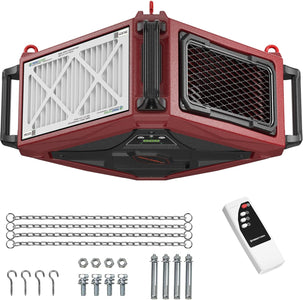
Size For: 1100 Sq.Ft
Airflow: 1080 CFM
Filter: MERV-11
Intake Design: 270° intake
Case Study – 1,800 sq ft Home with Pets
| Factor | Standard Air Purifier | HEPA Air Scrubber |
|---|---|---|
| Airflow | 100–300 CFM | 550–2,000 CFM |
| Coverage | Single room | Large rooms / whole-home zones |
| Filtration grade | Consumer HEPA | Medical/industrial HEPA H13 |
| Operation | Intermittent use | Continuous 24/7 operation |
| Durability | Consumer-grade | Industrial-grade |
Air scrubbers are significantly more effective for homes with pets, multiple allergy triggers, or high pollutant loads.
In addition to particle capture, advanced air scrubbers use multiple technologies to reduce biological and chemical allergens.
| Technology | Function | Benefit |
|---|---|---|
| UV-C light (254nm) | Disrupts microorganisms at DNA level | Reduces bacteria and mold spores |
| Ionization | Charges airborne particles | Helps particles cluster for easier capture |
| Activated carbon | Adsorbs odors and VOCs | Reduces pet odors and chemical irritants |
Important: Abestorm air scrubbers are designed to operate safely in occupied spaces without harmful ozone emissions.
| Home Size | Allergy Severity | Recommended Model | Key Benefit |
|---|---|---|---|
| Small (<800 sq ft) | Mild–moderate | HEPA 600 UVIG | Compact, efficient allergen control |
| Medium (800–1,500 sq ft) | Moderate | HEPA V1 or HEPA S1 | Balanced airflow + coverage |
| Large (>1,500 sq ft) | Severe / multiple pets | HEPA 2000 UVIG | High-capacity whole-home filtration |
| Workshop / dusty area | Heavy dust exposure | DecDust 1080IG | High-volume particle control |
Case Study – 1,800 sq ft Home with Pets
Can air scrubbers help with pet allergies?
Yes. HEPA H13 filters capture pet dander that standard HVAC filters often miss.
How often should I replace filters?
Typically every 6–12 months. Homes with pets or heavy allergens may require more frequent replacement.
Do air scrubbers remove dust mites?
They capture airborne allergens from dust mites. However, cleaning bedding and vacuuming is still necessary.
What’s the difference between HEPA and MERV filters?
HEPA H13 is more efficient than MERV-rated filters, capturing 99.97% of particles ≥0.3 microns.
Can air scrubbers reduce seasonal pollen?
Yes. They are especially effective when placed near entry points like windows and doors.
Can I run an air scrubber 24/7?
Yes. Continuous operation provides the best long-term allergy control.
Effective allergy control requires continuous removal of airborne irritants—not just filtration at the HVAC level.
HEPA air scrubbers provide high-efficiency, continuous air cleaning that targets:
For best results, combine proper unit sizing with continuous operation in high-traffic areas.
Explore Abestorm HEPA air scrubbers to build a cleaner, healthier indoor environment.