Cart
Your cart is empty


Wood dust is more than a cleaning inconvenience—it is a serious occupational health hazard.
Fine and ultra-fine particles can remain airborne for hours, penetrate deep into the lungs, and increase the risk of asthma, chronic respiratory disease, and even nasal cancer with long-term exposure.
A properly protected woodworking shop requires a two-layer air quality strategy:
Abestorm DecDust dust collectors and HEPA air scrubbers work together to maintain a cleaner, safer, and more efficient workshop environment.
| Dust Type | Size Range | Source | Health Risk |
|---|---|---|---|
| Health Risk | 10–100 microns | Sawing, planing | Eye irritation, visible buildup |
| Fine dust | 2.5–10 microns | Sanding, routing | Respiratory irritation, asthma triggers |
| Ultra-fine dust | <2.5 microns | All woodworking processes | Deep lung penetration, long-term cancer risk |
| Hardwood dust | Variable | Oak, walnut, cherry | Increased nasal cancer risk (carcinogenic classification in occupational studies) |
Fine and ultra-fine dust are the most dangerous because they remain suspended in the air for extended periods and are easily inhaled.According to OSHA and NIOSH guidelines, airborne hardwood dust exposure should be strictly controlled below recommended limits.
HEPA air scrubbers continuously remove airborne dust at the source, preventing particles from settling or spreading throughout the site.
OSHA permissible exposure limit (PEL):
Dust collectors are the first line of defense, capturing wood dust directly at the source before it becomes airborne. Abestorm DecDust units are engineered for woodworking environments, delivering high airflow performance and efficient particle capture.
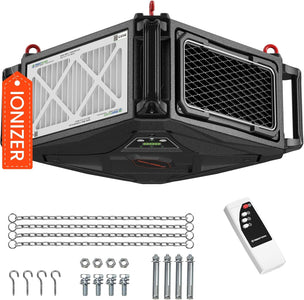
Size For: 800 Sq.Ft
Airflow: 780 CFM
Filter: MERV-11
Intake Design: 270° intake
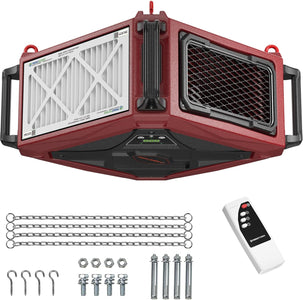
Size For: 1100 Sq.Ft
Airflow: 1080 CFM
Filter: MERV-11
Intake Design: 270° intake

Size For: 1700 Sq.Ft
Airflow: 1350 CFM
Filter: MERV 11
Intake Design: 360° intake

Size For: 1100 Sq.Ft
Airflow: 850-1050 CFM
Filter: MERV-13
Intake Design: 180° intake
High CFM airflow supports multiple tools and longer duct runs
270° / 360° intake design improves multi-directional capture efficiency
OSHA permissible exposure limit (PEL):
Even with a dust collector, a significant amount of fine and ultra-fine dust remains suspended in the air. HEPA air scrubbers provide continuous ambient filtration to remove these residual particles.

Coverage: 1100 Sq.Ft
Airflow: 750 CFM
Filter: MERV-10 + 2-in-1 HEPA/Carbon
UV-C: Yes

Coverage: 2500 Sq.Ft
Airflow: 2000 CFM
Filter: MERV-10 + HEPA 13
UV-C: Yes
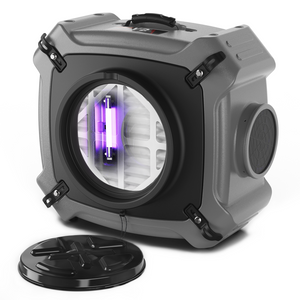
Coverage: 800 Sq.Ft
Airflow: 550 CFM
Filter: MERV-10 + 2-in-1 HEPA/Carbon
UV-C: Yes
| Shop Size | Dust Collector | Air Scrubber | Expected Result |
|---|---|---|---|
| Small (<800 sq ft) | DecDust 780 | HEPA V2 | Basic source + ambient control |
| Medium (800–1,500 sq ft) | DecDust 1080 | HEPA V1 | Balanced full-shop protection |
| Large (>1,500 sq ft) | DecDust 1350 | HEPA 2000 UVIG | Industrial-grade air control |
| High-fine-dust focus | DecDust 1050 (MERV-13) | HEPA V1 or 2000 UVIG | Maximum filtration efficiency |
Pro Tip:For shops with multiple stationary machines, a centralized DecDust 1350 system combined with HEPA air scrubbers delivers the most stable air quality performance.
| Equipment | Placement | Best Application |
|---|---|---|
| Negative air machine | Containment exhaust point | Seal ducting tightly, vent outdoors when possible |
| Air scrubber | Near dust source | Place close to cutting/sanding/demolition zones |
| Ducting | Exhaust routing | Keep short and avoid sharp bends |
| Containment barrier | Entire work zone | Use 6-mil plastic, seal all seams, install zipper doors |
Setup Steps
| Workshop Type | Configuration | Key Benefit |
|---|---|---|
| Hobby garage | DecDust 780 + HEPA V2 | Affordable entry-level protection |
| Small professional shop | DecDust 1080 + HEPA V1 | Continuous air quality control |
| Large commercial shop | DecDust 1350 + HEPA 2000 UVIG | Full-shop industrial coverage |
| Finishing / spray area | DecDust 1050 + HEPA V1 (carbon) | VOC + fine dust removal |
Q1: How much CFM do I need?
Typically 350–500 CFM per stationary tool. Larger setups may require 1,000+ CFM depending on layout.
Q2: Do I need both systems?
Yes. Dust collectors handle source capture; air scrubbers handle airborne residual dust.
Q3: How often should filters be replaced?
Dust collectors: 2–4 weeks depending on use HEPA filters: 6–12 months depending on workload
Q4: HEPA vs MERV filters?
HEPA H13 captures 99.97% at 0.3 microns, significantly outperforming MERV filters for ultra-fine dust.
Q5: Can I use an air scrubber alone?
No. It cannot capture dust directly at the source.
Q6: How do I measure air safety?
Use a particle counter; aim for PM2.5 levels below 35 μg/m³ during operation.
Effective woodworking dust control requires a dual-system strategy:
Together, they significantly reduce airborne dust exposure, improve shop cleanliness, and enhance long-term respiratory safety.
Recommended combinations:
Build a safer, cleaner, and more productive workshop with Abestorm air filtration solutions.