Cart
Your cart is empty


Mold is more than a cosmetic issue—it is a serious indoor air quality hazard that can damage building materials and impact respiratory health.
When indoor humidity exceeds 60%, mold spores can begin germinating within 24–48 hours, rapidly spreading across porous surfaces such as drywall, wood, and insulation.
Effective mold remediation requires two coordinated actions:Using high-capacity dehumidifiers together with HEPA air scrubbers ensures complete remediation and significantly reduces the risk of mold recurrence.
| Risk Type | Impact |
|---|---|
| Respiratory issues | Asthma triggers, allergic reactions, coughing, wheezing |
| Structural damage | Wood rot, drywall deterioration, insulation breakdown |
| Property value loss | Visible mold reduces market value and complicates sales |
| Long-term exposure | Chronic sinus infections and immune system irritation |
Common indoor molds include Aspergillus, Penicillium, and Stachybotrys (black mold).
Frequent growth areas include basements, crawl spaces, bathrooms, attics, HVAC systems, and behind drywall.

Moisture control is the foundation of mold remediation. Without removing excess humidity, mold will continue to grow even after cleaning. When to Use:

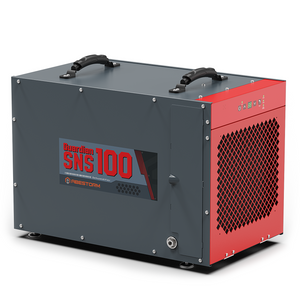
Size For: 2,600 Sq.Ft
Drainage: Gravity
Capacity: 198 (Sat) | 90 (AHAM) PPD
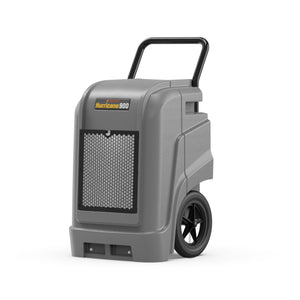
Size For: 2,900 Sq.Ft
Drainage: Water Pump
Capacity: 220 (Sat) | 100 (AHAM) PPD
Size For: 2,600 Sq.Ft
Drainage: Condensate Pump
Capacity: 190 PPD (Sat) | 90 PPD (AHAM)
Moisture control is the foundation of mold remediation. Without removing excess humidity, mold will continue to grow even after cleaning. When to Use:
Mold spores are typically 2–10 microns in size and can remain airborne for extended periods. HEPA air scrubbers capture these spores before they settle or spread through HVAC systems.
When to Use:
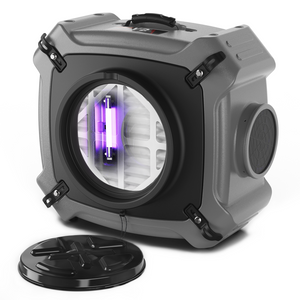
Coverage: 800 Sq.Ft
Airflow: 550 CFM
Filter: MERV-10 + 2-in-1 HEPA/Carbon
UV-C: Yes

Coverage: 1100 Sq.Ft
Airflow: 750 CFM
Filter: MERV-10 + 2-in-1 HEPA/Carbon
UV-C: Yes

Coverage: 2500 Sq.Ft
Airflow: 2000 CFM
Filter: MERV-10 + HEPA 13
UV-C: Yes
| Step | Action | Equipment | Expected Outcome |
|---|---|---|---|
| 1 | Identify & fix moisture source | Moisture meter, inspection tools | Stop active water intrusion |
| 2 | Set up containment | Plastic sheeting, negative air machines | Prevent spore spread |
| 3 | Deploy dehumidifiers | High-capacity units | Reduce humidity below 50% |
| 4 | Install air scrubbers | HEPA units near affected zones | Capture airborne spores |
| 5 | Remove contaminated materials | PPE, HEPA vacuum, disposal bags | Eliminate mold reservoirs |
| 6 | Clean & disinfect surfaces | Antimicrobial solutions | Remove remaining contamination |
| 7 | Continue air filtration | Air scrubbers (24–48 hrs+) | Capture residual spores |
| 8 | Verify dryness | Moisture meter, hygrometer | Confirm successful remediation |
Pro Tip: Maintain dehumidifier operation until humidity remains below 50% for at least 48 hours, and continue running air scrubbers during and after cleaning to capture disturbed spores.
| Space Size | Mold Severity | Recommended Configuration | Expected Result |
|---|---|---|---|
| Small (≤800 sq ft) | Light surface mold | Guardian SN55S + HEPA V2 | Stable humidity <50%, reduced spores |
| Medium (800–2,000 sq ft) | Moderate growth | Guardian SN90 + HEPA V1 | Full moisture control + air purification |
| Large (≥2,000 sq ft) | Severe contamination | Guardian SNS100 + HEPA 2000 UVIG | Complete remediation, commercial-grade control |
Tip:For crawl spaces, install a vapor barrier. For persistent basement moisture, encapsulation combined with continuous dehumidification helps prevent recurrence.
Scenario: 1,800 sq ft basement with black mold on drywall and insulation, humidity at 78%, persistent musty odor
Solution: Guardian SN90 + HEPA V1
Process & Results:
Outcome: Full remediation achieved. Humidity maintained below 50% with no detectable odor.

What humidity level prevents mold growth?
Mold growth slows significantly below 50% relative humidity. However, existing mold must still be physically removed.
Can a dehumidifier alone remove mold?
No. Dehumidifiers stop growth conditions but do not remove airborne spores or existing colonies.
How long should air scrubbers run during remediation?
Continuously during cleaning and at least 24–48 hours afterward to capture disturbed spores.
Which is more important for mold removal: dehumidifier or air scrubber?
Both are essential—dehumidifiers control moisture, air scrubbers remove spores.
Do I need professional mold remediation?
Yes, for areas larger than 10 sq ft, HVAC contamination, or suspected black mold.
Can mold come back after remediation?
Not if moisture sources are eliminated and humidity is consistently maintained below 50%.
Mold remediation requires a dual-control strategy:
For best results, combine a properly sized Guardian dehumidifier with a HEPA air scrubber until humidity stabilizes below 50% and indoor air quality is restored.