

Introduction
A damp basement can cause several problems, including musty odors, mold growth, condensation, and damage to stored items. A regular household dehumidifier may not provide enough moisture removal for a large or consistently damp basement. In such cases, a commercial-grade unit can be a better choice. The best commercial dehumidifier for a basement should offer enough moisture removal capacity, reliable drainage, and the ability to operate in cooler conditions.
What to Look for in a Commercial Basement Dehumidifier
Look at four things: capacity, test conditions, drainage and the lowest working temperature. "Commercial" is a sales label, not a formal rating. Check the spec sheet, not just the name.
Capacity and Test Conditions
Capacity is how much water a unit pulls from the air in 24 hours. It is measured in PPD. The test conditions matter. ENERGY STAR introduced a new testing procedure that measures dehumidifier capacity at 65°F instead of the previous 80°F condition. This change provides a better picture of how portable dehumidifiers perform in cooler conditions. However, the difference between old and new capacity ratings varies by model.
Cool air holds less water, so the same machine removes less in a cool basement. Only compare capacity numbers that use the same test conditions. A "saturation" number is measured at 90°F and 90% relative humidity (RH). It shows peak output, not a normal day.

Next, pick a humidity goal. The EPA says to keep indoor humidity below 60%, and ideally between 30% and 50%. A cheap hygrometer will show you where your basement stands. Check the coverage area on the label too. A very wet basement may need more capacity than that area suggests. This basement moisture control guide explains how to choose and set up a unit.
One more point: a dehumidifier does not fix leaks. The EPA notes that water can get in through leaks or seep through basement floors. Fix the source first.
Drainage and Temperature Range
A built-in tank fills fast in a damp basement. A drain hose that runs to a floor drain or sump saves you from emptying it. Gravity drainage works only if the drain sits lower than the unit. If the water has to go uphill, you need a condensate pump.
The cold is another problem. Frost can build on the coils in cold air and slow the unit down. Auto defrost helps by stopping the compressor while the fan keeps running, which lets the frost melt. Look up the lowest working temperature before you buy. A few smaller things also help which are:
- A washable filter
- Easy controls and auto restart after a power cut
- A weight you can handle on stairs
- A low noise level if the basement is finished
- A long warranty
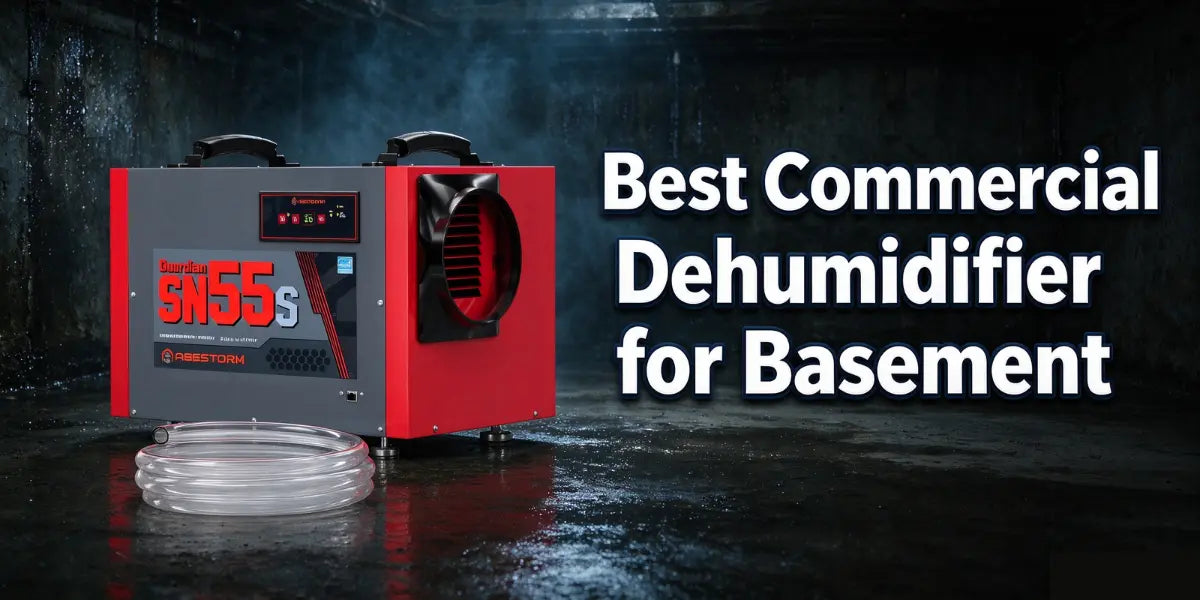
Abestorm 120 PPD Crawl Space Dehumidifier: A Closer Look

The Abestorm 120 PPD Crawl Space Dehumidifier with Drain Hose suits damp basements that need a steady drain and cool-air use. Abestorm sells it as the Guardian SN55S and lists it as ENERGY STAR certified. The listing says it covers up to 1,300 square feet.
Specifications and Basement Fit
|
Specification |
Listed Value |
|
Capacity (80°F, 60% RH) |
55 pints per day |
|
Maximum (90°F, 90% RH) |
120 pints per day |
|
Coverage |
Up to 1300 sq ft |
|
Airflow |
130 CFM |
|
Working Temperature |
33.8°F to 104°F |
|
Filter |
MERV-8 |
|
Drain hose |
6.5 ft, gravity drain |
|
Sound Level |
50 dBA |
|
Weight |
41.7 lb |
|
Warranty |
5-Year limited |
The 120-pint number is a saturation rating. The 55-pint number comes from an 80°F test, so output in a cool basement may be lower. The 33.8°F low limit and auto defrost suit basements that are not heated. The hose uses gravity, so the drain has to sit below the unit. If your drain is higher.
The unit weighs 41.7 lb. It has handles, but two people may find stairs easier. At 50 dBA, it may be audible in a finished room. If your basement is a workshop or storage space, Abestorm's guide to commercial and industrial dehumidification covers bigger spaces.
Why Consider This Model for Your Basement?
The Guardian SN55S has several features that make it worth considering for basement use.
- Compact design: Its relatively small size makes it easier to position in areas where floor space is limited. It also has handles for easier transportation.
- Automatic defrost: The unit includes an automatic defrost system that helps manage frost buildup during low-temperature operation. This is useful in basements that remain cool throughout the year.
- Continuous drainage: The included drain hose allows collected water to flow away automatically through gravity drainage. You do not need to empty a water tank regularly.
- Flexible installation: The unit supports ducting options, which can help distribute dry air into different sections of a basement. This can be useful when walls divide the space into separate areas.

FAQ
What size dehumidifier do I need for a basement?
Start with your floor area and how damp the room feels. Then compare capacity numbers that use the same test conditions. A unit listed for 1,300 square feet, like the Abestorm model, may fit a large open basement. A very wet or divided basement may need more capacity or a second unit.
What humidity level should I aim for in a basement?
The EPA says below 60%, and ideally 30% to 50%. Put a hygrometer in the basement and adjust the setting until the reading stays in that range.
Can a commercial dehumidifier drain on its own?
Many can. A hose runs to a floor drain or sump. A gravity hose needs a drain below the unit. If the water has to go uphill, choose a model with a pump or add a condensate pump.
Will a dehumidifier stop a leaking basement?
No. It lowers humidity in the air, but it does not stop water from coming in. Repair the source first. Then use the unit to handle the leftover moisture.
Conclusion
The best commercial dehumidifier for a basement fits your space, works in cool air and drains without daily effort. Compare capacity at the same test conditions, aim for 30% to 50% humidity, and fix any leaks first. For a large damp basement, the Abestorm 120 PPD Crawl Space Dehumidifier with Drain Hose lists 1,300 square feet of coverage, a 33.8°F low limit and a gravity drain hose. Check your drain layout and ask for cool-air data before you buy.
Related articles:
Shop For Dehumidifier
Abestorm 270 PPD 3,000 Sq.Ft Commercial Dehumidifier with Pump, Filters and Drain Hose | Hurricane 1250
Abestorm 180 PPD 2,300 Sq.Ft Commercial Dehumidifier with Pump and Drain Hose | Hurricane LGR85
Abestorm 170 PPD 2,100 Sq.Ft Commercial Dehumidifier with Pump and Drain Hose | Hurricane 800
Abestorm 180 PPD 2,300 Sq.Ft Commercial Dehumidifiers with Pump and Drain Hose | Hurricane 85P