

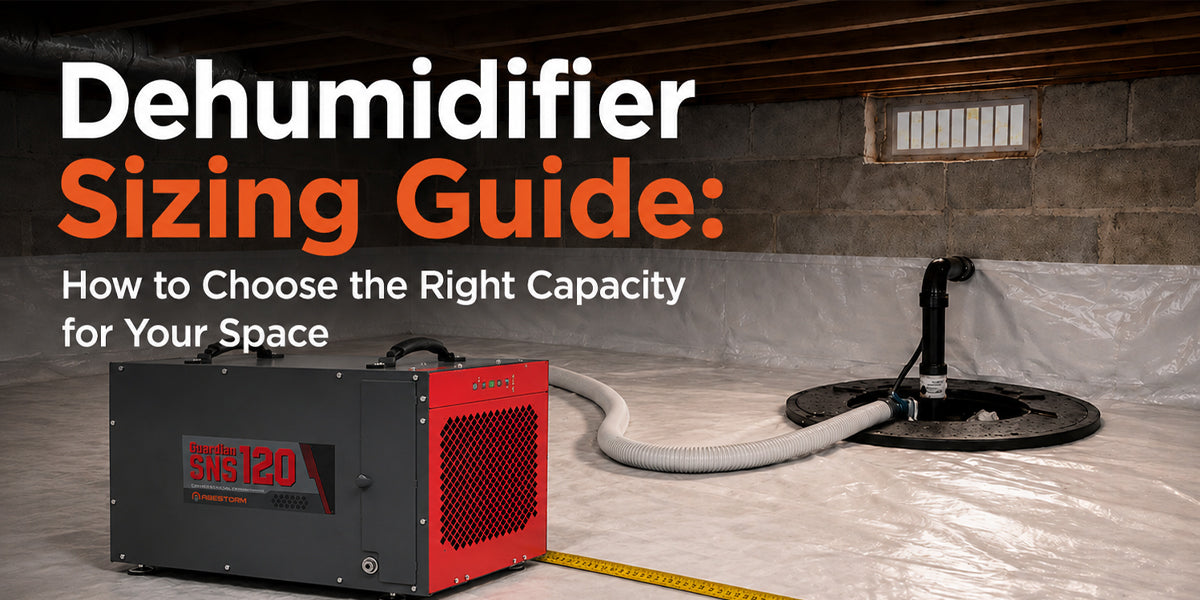

You have a dehumidifier in the basement, yet it still feels damp. Or perhaps the unit is running non-stop, driving up your electricity costs with little to show for it in terms of lower humidity. Do not assume the machine itself is of poor quality; more often than not, the trouble lies in having selected the wrong capacity.
An undersized dehumidifier will work hard but fail to remove enough moisture from the air, creating an uncomfortable environment and a unit that never seems to shut off. Go too large, and you risk short-cycling, where the compressor cycles on and off in quick succession without any real efficiency.
Getting the right size is not as simple as looking at a room’s square footage and picking a pint rating. One must also consider the space, the temperature, the drainage setup, and how often it is called upon to run. This dehumidifier sizing guide will walk you through what dehumidifier capacity really means, the impact of the 2020 Department of Energy (DOE) testing standard on pint ratings, and how to read a dehumidifier capacity chart to make the right choice. We will also touch on drainage, energy use, and Abestorm models suitable for everything from residential to commercial use.

Step 1- Understanding “Pints” — What Does Dehumidifier Capacity Actually Mean?
In technical terms, capacity is the volume of water a dehumidifier can extract from the air in a day, measured in pints. A 50-pint model receives this rating because, under controlled conditions, it can remove that amount of moisture. In practice, however, the figure is a performance rating, not a measure of room size. Your home’s insulation, airflow, and ambient temperature will all affect the actual results.
When deciding how to choose a dehumidifier, understanding pint capacity is essential because the right rating depends on the environment where the unit will operate, not only the size of the room.
The 2020 DOE Standard
If you are in the market for a new dehumidifier, be aware of the shift in the DOE testing protocol. Prior to 2020, units were generally tested at 80°F and 60% relative humidity (RH). The current standard has lowered the test temperature to 65°F while keeping the RH at 60%. This is a more accurate reflection of many basements and crawl spaces. Since cold air holds less moisture, the numbers on labels have decreased; a 50-pint unit by today’s standards may perform as well as an old 70-pint model did. Use the current DOE rating when comparing models.
Is Bigger Better?
We tend to recommend erring on the side of a larger unit. An undersized one will wear out faster and consume power in a futile attempt to reach the target humidity. A well-sized, slightly larger unit gets the job done in fewer cycles. But there is a point of diminishing returns with excessive oversizing, so the aim is to match capacity to the space's conditions, not to purchase the largest unit available.
Step 2- Sizing Chart — How Much Capacity Does Your Space Need?
To answer the question of what size dehumidifier do I need, you have to look at both the area and the moisture in it.
First, do the math on the square footage. Multiply length by width. For a 25-by-20-foot room, that is 500 square feet. With an odd-shaped room, break it down into rectangles and add them up. But keep in mind that 1,000 square feet of finished living space is not the same as 1,000 square feet of a wet basement.
Then you have to gauge the moisture. Is there a musty smell only when the weather is humid, or are you seeing condensation on the walls?
Moisture Level / Typical Signs
|
Moisture Level |
Typical Signs |
|
Moderately Damp |
50-60% RH, musty odor in humid weather, but no visible stains. |
|
Very Damp |
60-70% RH, some condensation, damp floors, and a persistent smell. |
|
Wet |
70-80% RH, water stains and mold are apparent. |
|
Extremely Wet |
80-90% RH, standing water, and extensive mold. |

Step 3- Recommended Capacity
For a general idea of what you should choose, refer to the chart below. It is based on the 2020 DOE guidelines from Consumer Reports.
Dehumidifier Capacity Chart
|
Space Area / Relative Humidity |
400 sq. ft. |
600 sq. ft. |
800 sq. ft. |
1,200 sq. ft. |
|
50-60% (Moderately Damp) |
20 pints |
25 pints |
35 pints |
50 pints |
|
60-70% (Very Damp) |
20 pints |
30 pints |
40 pints |
50 pints |
|
70-80% (Wet) |
25 pints |
35 pints |
45 pints |
55 pints |
|
80-90% (Extremely Wet) |
30 pints |
40 pints |
50 pints |
60 pints |
Higher humidity levels require more capacity, regardless of square footage. For a quick reference, the simplified sizing guide follows. Sizing Guide for Abestorm Dehumidifiers
The following table outlines the recommended capacity in pints based on space conditions and square footage:
|
Space Condition |
500 sq. ft. |
1,000 sq. ft. |
1,500 sq. ft. |
2,500+ sq. ft. |
|
Moderately Damp |
20 |
30 |
40 |
50 pints |
|
Very Damp |
30 |
40 |
50 |
60 pints |
|
Wet |
40 |
50 |
60 |
70+ pints |
|
Extremely Wet |
50 |
60 |
70 |
Commercial grade |
Some environments call for more than what the standard chart would have you think. In a basement or an unheated crawl space, it is advisable to go up at least one size category. The cooler air can hamper compressor efficiency, so the unit will need the extra headroom to control humidity. The same applies to rooms with poor ventilation, multiple windows, high ceilings, or those that are kitchens and laundry areas; an additional 5-10 pints of capacity can make a difference in performance.

Abestorm Dehumidifier Sizing Guide
Picking a dehumidifier is not simply a matter of measuring the room. One must also take into account the severity of moisture, the unit's installation location, drainage needs, and other factors. Abestorm has models suitable for everything from a small crawl space to a commercial setting. This dehumidifier sizing guide is intended to help you pair the right model with the job and understand how to choose a dehumidifier for your specific application.
|
Model |
Capacity |
Recommended Coverage |
Best Use |
|
35 pints/day |
Up to 1,000 sq. ft. |
Ideal for tight spots and small basements |
|
|
55 pints/day |
Up to 1,300 sq. ft. |
Suitable for mid-sized crawl spaces and standard basements |
|
|
90 pints/day |
Up to 2,600 sq. ft. |
Designed for large basements and whole-space humidity control |
|
|
80 pints/day |
Up to 2,100 sq. ft. |
Built for light commercial applications, warehouses, and restoration work |
|
|
125 pints/day |
Up to 3,000 sq. ft. |
Industrial-grade option for large moisture-control applications |
All of these come with the features necessary for continuous control in tough conditions. Whether it is the compact design of the SN55S for confined areas or the commercial durability of the Hurricane 800, each has its place. A homeowner would do well to match the environment as closely as the pint rating; a small crawl space does not warrant a commercial unit, but a large, damp basement might require one with higher capacity and a continuous drainage setup.
For proper basement dehumidifier sizing, selecting a model based only on square footage may not be enough. The moisture level, operating temperature, and drainage requirements should also influence the final decision.
Product Feature Summary
|
Model |
Drainage |
Low-Temp |
Auto Defrost |
Notes |
|
Guardian SN35P |
Gravity/pump |
✓ |
✓ |
Lightweight |
|
Guardian SN55S |
Gravity/pump |
✓ |
✓ |
Compact |
|
Guardian SN90 |
Gravity/pump |
✓ |
✓ |
High capacity |
|
Hurricane 800 |
Gravity/pump |
✓ |
✓ |
Commercial grade |
|
Hurricane 1250 |
Gravity/pump |
✓ |
✓ |
Maximum capacity |
Step 4- Key Sizing Parameters Beyond Capacity
While capacity is the starting point, long-term effectiveness depends on other factors such as energy use, temperature range, and installation. A complete dehumidifier sizing guide should consider these factors because they directly affect performance and reliability.
1. Drainage Options (Critical for Basement Installations)
How the system disposes of the extracted water is a key factor, particularly in a basement.
Gravity Drain
With a hose running to a floor drain or some other low point, this is a straightforward solution, provided the outlet is lower than the dehumidifier and the hose can be kept on a downward slope. There are no extra parts to worry about, though placement is dictated by the drain's location.
Built-In Condensate Pump
If gravity is not an option, a pump will push the water up to a sink or pipe. This is very handy for below-ground basements or any area without a floor drain, as it allows for hands-off, continuous operation.
Water Bucket
Fine for a temporary issue in a small room, but for a large basement or a high-humidity space, having to empty a tank regularly is hardly practical.
For basement dehumidifier sizing, drainage should always be considered alongside capacity. A properly sized unit without a suitable drainage method may require unnecessary maintenance and interruptions.
2. Low-Temperature Performance
Compressors tend to struggle in the cold. Below 65°F, a standard unit may see its efficiency drop and frost form on the coils. Since basements and crawl spaces are often cooler than the rest of the house, this is something to consider.
Abestorm units are equipped with auto-defrost to keep things running smoothly and can operate reliably down to 33°F.
Low-temperature operation is especially important when deciding what size dehumidifier do I need because a unit that performs well in warm conditions may not provide the same results in a cold basement or crawl space.
3. Efficiency and Noise
Given that a dehumidifier can run for hours, operating costs are a concern. Our ENERGY STAR certified options are designed to keep electricity consumption in check while maintaining effective moisture removal.
Noise is another factor to consider. In a bedroom, one would want something at 45 dBA or less for comfort, whereas in a basement, 50-55 dBA is generally fine.
Energy efficiency becomes especially important for units that operate continuously. A more efficient model can help reduce long-term operating costs while maintaining the desired humidity level.
4. Installation Type
The installation method will affect which dehumidifier one chooses.
Portable Dehumidifiers
Designed for easy setup and mobility, these units do not require any permanent installation. They are well suited to an apartment or a single room, particularly where there is a temporary humidity issue to resolve. Their value lies in the flexibility they offer; if seasonal moisture becomes an issue, a portable can be relocated to another part of the house.
Fixed Installation Systems
If the space is large and requires constant operation, a fixed system is the better option. One will see them in commercial properties, expansive basements, or crawl spaces where you need to control the entire area. For improved airflow, they can be connected to a permanent drain or the ductwork already in place. Such systems are preferred for continuous humidity management.
In sizing the unit, it is worth considering how often it will be used and what the installation entails.
FAQs
How large an area can a 50-pint dehumidifier cover?
By the 2020 DOE standard, such a unit will handle between 1,200 and 1,500 sq. ft. of a moderately damp basement.
Is it better to oversize or undersize? How do I balance it?
Most in the industry would advise a little oversizing. It is more efficient that way, and the larger unit may consume less energy overall by running shorter cycles. But do not overdo it, as short cycling should be avoided.
Why do new dehumidifiers seem to have smaller pint ratings than older models?
The DOE changed the testing temperature from 80 to 65 degrees with its 2020 standard, so the numbers have come down. In practice, however, the performance is on par with the higher-rated models of yesteryear.
What should I look for in a basement dehumidifier?
Look for auto-defrost and for something that can operate at low temperatures—standard units tend to falter below 65°F. A drainage pump is also highly recommended. All our Abestorm dehumidifiers have auto-defrost and will perform in temps as low as 33°F.
What is the Integrated Energy Factor (IEF)?
This metric, introduced in 2019 to replace the old EF, provides a truer account of yearly energy consumption by accounting for standby power.
Conclusion
Proper sizing is key to a dependable system and to avoiding wasted energy. A thorough guide to dehumidifier sizing considers far more than square footage alone; factors such as temperature, drainage, and humidity levels are all relevant. Use a capacity chart for a rough estimate, then tailor your choice to the conditions at hand. Be it for a wet crawl space or a commercial application, the right capacity ensures consistent control over moisture.
Shop For Dehumidifier
Abestorm 180 PPD 2,300 Sq.Ft Commercial Dehumidifier with Pump and Drain Hose | Hurricane LGR85
Abestorm 190 PPD 2,600 Sq.Ft Commercial Dehumidifier with Pump and Drain Hose | Hurricane 900
Abestorm 170 PPD 2,100 Sq.Ft Commercial Dehumidifier with Pump and Drain Hose | Hurricane 800
Abestorm 180 PPD 2,300 Sq.Ft Commercial Dehumidifiers with Pump and Drain Hose | Hurricane 85P